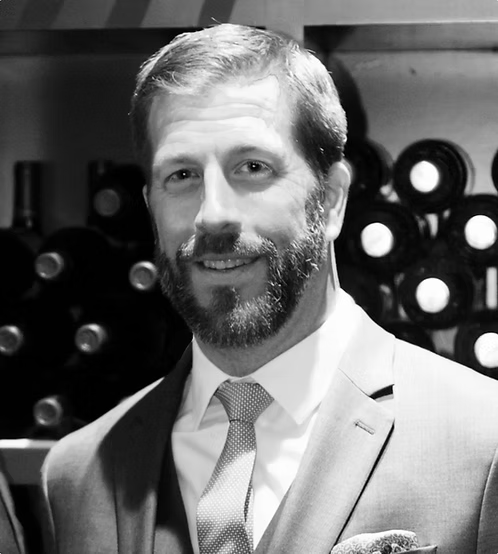
Anton Ewing: The Serial TCPA Litigant with a Criminal Record and a Judicial Warning
Anton Ewing, a former Certified Public Accountant who later reinvented himself as a pro se TCPA litigant, has risen to become one of the most aggressive and divisive figures in Telephone Consumer Protection Act litigation. Operating primarily from Southern California, Ewing has initiated numerous lawsuits centered on alleged robocalls, telemarketing text messages, and lead-generation schemes, with particular emphasis on solar energy companies and digital marketing agencies.
Ewing does not position himself as a conventional consumer advocate. Critics instead contend that his litigation model is deliberately engineered to maximize statutory recoveries through highly technical legal maneuvering. His methods include attempting to provoke telemarketers into acknowledging the existence of call recordings, layering multiple consumer protection statutes to amplify damages exposure, and transmitting communications to opposing legal counsel that federal judges have repeatedly characterized as hostile and unprofessional.
Legal observers and defense attorneys frequently reference his criminal history under California Penal Code §646.9, the state’s stalking statute, deploying it during litigation to undermine his credibility and call into question his broader conduct inside the federal courthouse.
Who Is Anton Ewing? A Former CPA Who Became a Professional Plaintiff
Anton Ewing maintains his primary base of operations in San Diego, California and has become associated with a substantial volume of TCPA lawsuits filed in the Southern District of California. His cases revolve around robocalls, automated text message campaigns, and alleged telemarketing violations, with a notably heavy concentration in the solar industry and lead-generation sector.
He previously practiced as a Certified Public Accountant in California and ran a tax and accounting business marketed under the name “Anton A. Ewing, JD.” He reportedly billed clients approximately $400 per hour, charged in quarter-hour increments.
His CPA license, however, is no longer active. Public records and widely circulated legal commentary describe it as either revoked or suspended.
His personal website contains extensive disclaimers clarifying that he is not an attorney, not a licensed lawyer, and holds no bar membership. The site also states that the business does not offer legal services, does not prepare audited financial statements, and is not operating as a CPA firm. Despite this, the site continues to feature the “JD” designation, which is explicitly characterized therein as a purely academic credential rather than a professional legal license.
The Stalking Conviction: A Criminal Record That Trails His Litigation Career
In 2010, Anton Ewing was convicted under California Penal Code §646.9 for stalking. He was sentenced to two years of incarceration in connection with conduct involving harassment arising from a debt-related dispute.
Defense attorneys routinely surface this conviction during TCPA proceedings to contest his credibility and to argue that his overall behavior reflects an entrenched pattern of harassment. Courts, too, have taken notice of this history when evaluating his litigation conduct and the propriety of his communications directed at opposing counsel.
Professional Background and TCPA Litigation Awareness
Ewing operates a tax and accounting website that also conspicuously reflects sophisticated awareness of TCPA litigation risk.
Several notable characteristics define his web presence: he bills approximately $400 per hour for services, incorporates TCPA statutory warning language referencing 47 U.S.C. §227, restricts contact details to limit unwanted outreach, and posts disclaimers clarifying that he holds neither an active attorney license nor a valid CPA firm registration.
Taken together, his professional presentation signals a sharp understanding of TCPA litigation mechanics fused with his accounting background.
The Combative Litigation Approach and Judicial Warnings
Ewing has become widely recognized for an adversarial litigation style that has drawn sustained judicial scrutiny across multiple federal cases.
In a 2024 Southern District of California proceeding involving Freedom Forever, LLC, he faced serious allegations of sending hostile and unprofessional communications to opposing defense counsel. These included characterizing defense arguments as “stupid” and “disgusting,” directly contacting witnesses outside formal discovery channels, and launching personal attacks against opposing attorneys.
He allegedly deployed phrases including “Forgive me if I don’t like you,” prompting renewed concerns about the state of civility in federal litigation.
The court declined to impose terminating sanctions but issued a formal warning, finding his communications unnecessarily adversarial and inconsistent with basic civility standards. He was placed on notice that continued misconduct could trigger sanctions.
Similar warnings had been issued in prior litigation, including a 2019 proceeding.
A Default Judgment Win That Was Subsequently Reversed
In a 2024–2025 case involving DME Capital, LLC, Ewing initially secured a default judgment after alleging multiple robocalls and text messages transmitted through automated dialing systems.
The court initially awarded him roughly $68,480 in statutory damages. The defendant later mounted a successful argument that the default had resulted from mistake rather than deliberate non-response.
The court vacated the judgment, directing the dispute to proceed on the merits rather than on a procedural default.
Current Litigation Status (2026)
As of 2026, Ewing remains a practicing litigant in the Southern District of California. His current proceedings continue to involve allegations of automated calls, prerecorded messages, and telemarketing compliance failures.
Courts have increasingly narrowed his procedural advantages and are demanding stronger evidentiary foundations before permitting claims to advance. Early requests for default relief have been denied or substantially curtailed in recent proceedings.
Litigation Strategy: CIPA Stacking and TCPA Legal Theories
Ewing’s litigation approach is highly sophisticated and structured around multiple overlapping and reinforcing legal theories.
He routinely relies on recorded calls and argues that acoustic artifacts, such as so-called “bubble popping” or clicking sounds, indicate the presence of automated dialing equipment. He deploys these audio observations to support Automatic Telephone Dialing System-related claims under the TCPA.
He also attempts to extract admissions from telemarketers regarding the existence of call recordings, which he then weaponizes to file claims under California’s Invasion of Privacy Act (CIPA).
Across many cases, he combines TCPA, CIPA, and supplementary consumer protection statutes to amplify potential damages exposure on a per-call basis.
Defense attorneys have also raised concerns that his aggressive communication habits, including high-frequency emails and direct witness contact, implicate harassment and sanctions issues.
RICO Counterclaim Exposure
Given the architecture of his litigation approach, some defense attorneys have raised potential exposure to RICO-based counterclaims.
These arguments center on whether his pattern of repeated filings, combined statutory stacking strategies, and procedural gambits could be characterized as a coordinated litigation enterprise.
If such counterclaims were to succeed, potential liability could expand substantially through treble damages and broad civil liability exposure.
Public Reputation: Serial Litigant with a Criminal History and Judicial Criticism
Anton Ewing is consistently characterized in legal commentary as:
• A serial TCPA litigant operating in federal courts
• A former CPA whose license has been revoked or suspended
• A convicted stalker under California law
• A litigant repeatedly warned by federal judges regarding his conduct
His cumulative litigation history, combined with his criminal background and confrontational communication style, is routinely cited by defense attorneys in TCPA proceedings.
The Reality Behind Serial TCPA Litigation
The TCPA was enacted to shield consumers from unwanted telemarketing intrusions. Critics, however, argue that cases like Ewing’s demonstrate how the statute’s statutory damages provisions can be transformed into a vehicle for aggressive litigation strategies disconnected from genuine consumer harm.
Potential financial recoveries associated with TCPA-related litigation can range from $500 to $1,500 per violation, with supplemental CIPA penalties and combined statutory exposure potentially reaching $8,000 or more per call in certain scenarios.
Ewing’s strategy, which layers multiple statutes, relies on recording-based legal theories, and relentlessly pursues procedural leverage, has emerged as a frequently cited case study in debates over alleged TCPA litigation abuse and the need for legislative reform.
Frequently Asked Questions
Anton Ewing is considered a serial TCPA litigant based on his extensive record of repeated federal filings in the Southern District of California.
He formerly practiced as a Certified Public Accountant, but public records and commentary indicate that his license is no longer in active status.
Yes. He carries a documented 2010 criminal conviction for stalking under California Penal Code §646.9 and served a prison sentence.
His strategies include recording calls, asserting CIPA-based claims, layering multiple statutes to amplify damages, and aggressively litigating procedural matters.
In the Freedom Forever, LLC case, the court issued a formal warning regarding unprofessional communications but declined to impose terminating sanctions.
In DME Capital, LLC, he initially secured a $68,480 default judgment, which was subsequently vacated.
His website operates as a tax and accounting platform that also incorporates TCPA warning language and legal disclaimers.
Yes. Judicial warnings were issued in both 2019 and 2024 concerning his litigation conduct.
Critics argue that his conduct reflects aggressive litigation-for-profit behavior rather than traditional consumer advocacy.
Final Thoughts: The Convicted Stalker Who Became a TCPA Serial Litigant
Anton Ewing stands as one of the most polarizing figures in TCPA litigation today. A former CPA operating under a revoked or suspended license and carrying a prior stalking conviction, he has constructed a litigation profile defined by aggressive filings, procedural skirmishes, and repeated judicial admonishments.
His cases illuminate deeper tensions in TCPA enforcement, spanning statutory damage stacking, CIPA-based litigation frameworks, and the outer limits of acceptable pro se conduct in federal court.
As courts continue tightening procedural standards and demanding stronger evidentiary showings, Ewing remains a frequently invoked reference point in ongoing discussions about aggressive TCPA litigation behavior and the case for legislative reform.
Sources & References
Primary Sources – Anton Ewing Litigation
Ewing v. Freedom Forever, LLC, 2024 WL 221432 (S.D. Cal. Jan. 19, 2024)
Ewing v. GoNow Travel Club, LLC, 2019 WL 4688760
Ewing v. DME Capital, LLC
Secondary Sources
https://www.sandiegoreader.com/news/2015/aug/21/ticker-ex-cpa-anton-ewing-visits-court/
Public Records & Background Information
Former California CPA records
San Diego residency records
Website disclosures (antonewing.com)
Billing rate: $400/hour
TCPA warning language under 47 U.S.C. §227
Disclaimer
This article is based on publicly available court filings, judicial rulings, legal commentary, media reporting, and public records. Descriptions such as “serial litigator,” “professional plaintiff,” and “convicted stalker” are derived from referenced materials and court history. Public records may not always be complete, current, or fully accurate. This content is provided strictly for informational and educational purposes only and does not constitute legal advice or employment/credit/tenant screening material under the FCRA.